
0%

Choosing a Half Cage Strength Rack in 2026 starts with your actual training space, not the number of attachments in a product photo. Measure the room, ceiling height, and floor area around the rack. Leave enough clearance to load a bar and move safely. Small details matter. Think about who will use it, which lifts you perform, and whether the rack must support solo training. A compact half rack may suit a home gym, while frequent heavy lifting can call for sturdier construction and carefully checked safety arms. Bigger is not always better.

Compare the frame dimensions, steel specifications, hole spacing, storage options, and the manufacturer’s stated weight ratings. Check whether the listed capacity applies to the entire rack or to individual parts, such as J-cups and spotter arms. A useful rating is only useful when its meaning is clear. Also consider assembly, floor protection, warranty terms, and the availability of replacement parts. This guide explains how to weigh those details, compare common designs, and avoid paying for accessories you may rarely use. Product descriptions can leave questions unanswered, so verify important specifications with the manufacturer before buying. Your choice should fit your routine and leave room to train comfortably. It may take a second look. That is sensible.
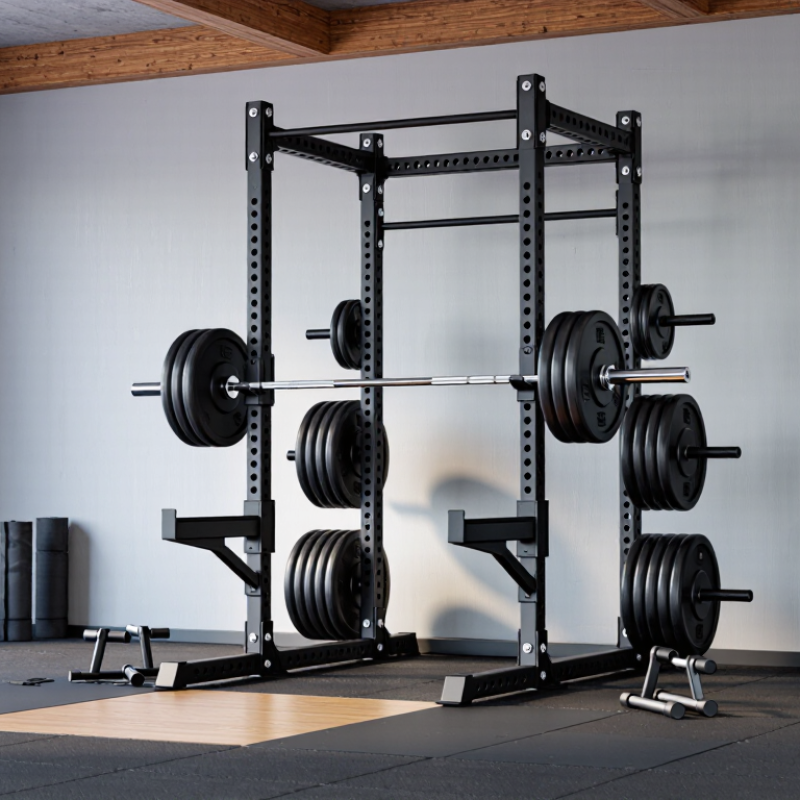
How to Choose a Half Cage Strength Rack in 2026?

What Is a Half Cage Strength Rack?

A half cage strength rack is an open-frame station for barbell training. It typically uses two main uprights, a connecting pull-up bar, and a stable base. J-cups hold the barbell at the chosen height, while adjustable safety arms can catch it if a lift stalls. Unlike a four-post power cage, the half rack leaves more sides open. That matters. You can step in and out easily, but the setup depends more on correct safety-arm placement and careful lifting.

Some models include weight-storage pegs or a landmine attachment, though these features are not essential to the rack’s basic purpose. Check the rack’s stated load limits, footprint, upright-hole spacing, and floor stability before choosing one. Measure the space with a loaded barbell, not just the frame; plates need room too. Not quite simple. “Half cage” is not a universal specification, so compare the actual frame and included safety parts rather than relying on the name. For home use, the right choice is a rack that fits your lifts, ceiling height, and available training space without crowding your movements.

How to Match Rack Size and Capacity to Your Training Space

A half cage should fit the room you actually have, not the room you hope to build. Measure the rack’s full footprint, then add space for the bar sleeves, plate changes, and a clear walk-around route. Check ceiling height with the bar raised overhead; low beams or a ceiling fan can make presses awkward. A tape measure helps. So does marking the rack outline on the floor before ordering.

Capacity matters just as much. Add your heaviest planned barbell load, then check the rack’s stated capacity for the intended use; do not treat user weight as equipment capacity. ASTM F2216 covers safety requirements and test methods for strength-training equipment, but it does not prescribe one ideal home-gym clearance. That depends on the rack, movements, and room layout. In ACSM’s 2024 Worldwide Survey of Fitness Trends, functional fitness ranked seventh among 20 trends, a useful reminder to leave room for movement beyond a static lift. I still measure twice. A half cage can look compact online and feel cramped when plates are loaded. For shared training, allow another person to move safely without crossing the bar path.

Which Safety Features and Attachments Should You Evaluate?

When choosing a half cage strength rack in 2026, inspect its safety system before counting attachments. Safety arms or straps should adjust securely and sit level on both sides. Check their rated capacity, then confirm it covers your intended lifts and working weight. J-cups need protective liners and a firm fit, without excessive movement. Small details matter. Review the rack’s footprint, base stability, and whether the maker recommends floor anchoring. A rack that shifts during setup deserves a closer look.

Tips: Test adjustments with the rack unloaded. Check that pins lock fully, holes are easy to reach, and safety catches sit at the height you need. Keep the manual nearby; guessing is not a feature.

For attachments, compare the rack’s hole size, spacing, and upright dimensions with each accessory’s requirements. A pull-up bar, dip handles, or weight storage may be useful, but compatibility is not universal. Think about the exercises you actually do and the room available around the rack. It is easy to overvalue a long accessory list. I would not assume that a heavier-looking attachment is automatically safer; verify its load rating and installation method. Recheck bolts and moving parts periodically, since home equipment can loosen with regular use.

How to Choose a Half Cage Strength Rack in 2026? – Which Safety Features and Attachments Should You Evaluate?

Evaluation Area What to Check Practical Selection Guidance Questions to Ask Before Buying
Spotter arms or safety bars Check that safeties are included or available, lock securely to the uprights, and are compatible with the rack’s hole pattern and dimensions. Choose safeties that can be set at the correct height for your lifts. Test their position with an unloaded bar before training. Are the safeties included? Which rack models and hole positions fit them?
Rack and attachment capacity Review the manufacturer’s stated capacity for the rack and for each attachment separately. Check whether ratings apply to a specific setup or use condition. Compare published ratings with the loads you plan to use, and follow the manufacturer’s limits and instructions. Do not assume every attachment has the same capacity as the rack. What are the rated capacities for the rack, safeties, J-cups, and any add-on equipment?
Stability and anchoring Inspect the base, feet, frame connections, and instructions for anchoring. Note whether the design requires floor fixing for particular exercises or attachments. Use the rack on a suitable, level surface and anchor it as directed. Check floor type and available space before installation. Is anchoring required or recommended, and what floor conditions and fasteners are specified?
Upright holes and adjustment range Compare hole spacing, hole diameter, upright dimensions, and the number of usable adjustment positions. More adjustment positions can help you set J-cups and safeties for different lifts and user heights. Confirm attachments match the exact rack specifications. What are the hole spacing and diameter, and are compatible attachments readily available?
J-cups and bar protection Check that J-cups fit securely and have protective contact surfaces where the bar rests. Confirm that the cups can be positioned evenly and at a suitable height. Replace worn or damaged protective surfaces according to the manufacturer’s guidance. Are J-cups included, and can replacement or alternate styles be fitted?
Frame dimensions and clearance Measure rack height, width, depth, and the space needed for a barbell, plates, and exercise movement. Allow room to load plates and move safely around the rack. Check ceiling height for overhead movements and any pull-up attachment. What are the assembled dimensions, and what clearance is recommended around and above the rack?
Pull-up bar Check whether a pull-up bar is included, its mounting position, and whether its height suits the room and intended users. Verify overhead clearance and the rack’s setup instructions before using the bar. Check any stated load limit separately. Is the pull-up bar included, adjustable, and covered by a separate capacity rating?
Plate storage and add-on attachments Review available storage pegs and optional attachments, such as dip handles, landmine posts, or cable systems. Check compatibility and attachment-specific instructions. Prioritize attachments that match your training needs and available space. Confirm whether adding or loading an attachment changes anchoring or stability requirements. Which attachments are compatible, sold separately, or subject to additional setup requirements?
Assembly, inspection, and maintenance Read assembly and maintenance instructions, including how to check fasteners, pins, welds, and moving or adjustable parts. Assemble and inspect the rack as instructed. Stop using any damaged, loose, or improperly fitted component until it has been checked or replaced. Are clear assembly instructions, replacement parts, and inspection guidance available?
Warranty and support Review warranty coverage, exclusions, duration by component, and the process for obtaining replacement parts. Compare written terms rather than relying on general warranty claims. Confirm coverage for the rack and separately sold attachments. What is covered, for how long, and how are service or replacement-part requests handled?

Note: Specifications and compatibility vary by model. Verify current manufacturer documentation, installation requirements, and attachment ratings before purchase and use.

How to Compare Rack Materials, Stability, and Construction

Choosing a half cage in 2026 means looking beyond its advertised load rating. ASTM A500/A500M specifies minimum yield strengths of 46 ksi for Grade B and 50 ksi for Grade C rectangular tubing. These figures describe steel strength, not the capacity of a finished rack. Tube dimensions, wall thickness, weld quality, and design all matter. Check that the seller identifies the tubing specification and publishes a clear, tested rack capacity. If those details are missing, treat the rating cautiously.

AISC’s Steel Construction Manual gives structural steel an elastic modulus of about 29,000 ksi. That measures stiffness, not resistance to failure, so thicker-looking steel alone proves little. Check the base width, upright connections, crossmembers, and bolt fit. On a level floor, the rack should feel planted during a controlled push; uneven feet or loose joints deserve attention. Small details count. Review the assembly instructions for anchoring requirements, and inspect welds for gaps or rough, inconsistent seams. I would not judge stability from a showroom glance alone; loaded movement can reveal weaknesses that a clean finish hides.

How to Choose a Half Cage Rack for Your Budget and Goals

How to Choose a Half Cage Strength Rack in 2026?

Choose a half cage rack by matching its structure to your training goals, available space, and realistic budget. For squats and bench presses, check the rack’s tested weight rating, safety arms, and upright thickness. A rack should feel stable when you rerack a heavy bar, not wobble across the floor. Measure your ceiling, platform area, and walking space before ordering. A tight corner can turn a useful rack into an annoying obstacle.

Tips: Set aside money for an adjustable bench, plates, and flooring. Check whether the rack includes spotter arms or requires separate accessories. Measure twice. Leave enough room to load plates safely. If you train alone, longer safety arms may offer more practical protection. Bolting the rack down can improve stability, but only when your floor and installation method support it.

Budget choices involve compromises. A lower-priced rack may provide strong uprights but fewer adjustment holes or limited accessory options. A premium model may offer smoother hardware and better expandability, yet those features matter less for simple home workouts. From practical use, I would prioritize stability, clear dimensions, and reliable safety components over appearance. I have also seen people overspend on attachments they rarely use. That mistake is easy to repeat. Reconsider your goals every few months, because your training needs may change.

FAQS

What is a half cage strength rack?

It is an open-frame station with two uprights, J-cups, and adjustable safety arms. Many models also have a pull-up bar.

How does it differ from a full power cage?

A half rack has more open sides, so stepping in and out is easier. That openness makes correct safety-arm placement especially important.

What measurements should I check before choosing one?

Measure the rack, loaded barbell, plate space, and walk-around route. Check ceiling height for overhead lifts, too. Measure twice.

How much room should I leave around the rack?

Leave space for bar sleeves, changing plates, and moving safely. Mark the rack’s outline on the floor to check the fit.

How do I choose the right weight capacity?

Compare the stated capacity with your heaviest planned barbell load and intended use. User body weight is not equipment capacity.

Are safety arms necessary?

Adjustable safety arms can catch the bar if a lift stalls. Set them for each exercise and verify their position before lifting.

Are storage pegs or a landmine attachment essential?

No. They may be useful, but they are optional features. Prioritize fit, stability, and suitable safety parts.

Why can a compact rack still feel cramped?

Loaded plates and bar sleeves need more room than the frame alone suggests. Online photos fool me sometimes; I should measure the actual space.

Conclusion

Choosing the right Half Cage Strength Rack in 2026 starts with understanding how it supports barbell training while using less floor space than a full power cage. Evaluate the rack’s height, width, depth, and weight capacity against your training area, ceiling clearance, flooring, and expected lifting loads. A compact design may suit home gyms, while a larger and heavier structure can provide greater stability for demanding workouts.

Safety and versatility should also guide your decision. Look for dependable safety arms or straps, secure J-cups, pull-up options, and attachment compatibility that support exercises such as squats, presses, and rack pulls. Examine the steel thickness, weld quality, base design, anchoring options, and overall finish to judge durability and stability. Finally, balance your budget with your goals: beginners may prioritize essential safety features and adjustability, while experienced lifters may benefit from higher capacity, expanded attachments, and stronger construction.

Amelia

Amelia

Amelia is a professional marketing specialist with a deep understanding of the company’s products, services, and the needs of the customers they are designed to support. She regularly contributes expert articles to the company website, sharing clear, practical insights that help readers compare......