Choosing a reliable Plate-Loaded Leg Press requires more than comparing glossy product photos. Global buyers need equipment that performs consistently, ships safely, and fits local training environments. This guide examines ten leading machines through practical criteria, including frame strength, carriage travel, footplate size, loading capacity, and user comfort. Small details matter. A smooth bearing system can reduce noise during heavy sets. A wide platform can improve foot placement for different athletes.
Our comparison also considers manufacturer experience, warranty coverage, spare-part access, and documented safety information. These factors often matter more than an impressive maximum-load number. Buyers should check steel thickness, weld quality, assembly requirements, and import conditions before ordering. Regional service support can prevent long interruptions when a handle, pad, or bearing needs replacement. No ranking is perfect. User height, gym traffic, available floor space, and budget can change the best choice. We may favor balanced performance over extreme loading claims, because everyday reliability is easier to verify. Photos can mislead. Ask for technical drawings, testing details, and maintenance guidance where possible. The machines below are selected to help commercial gyms, private facilities, and international distributors compare options with greater confidence. Expect useful differences, not a single universal winner.
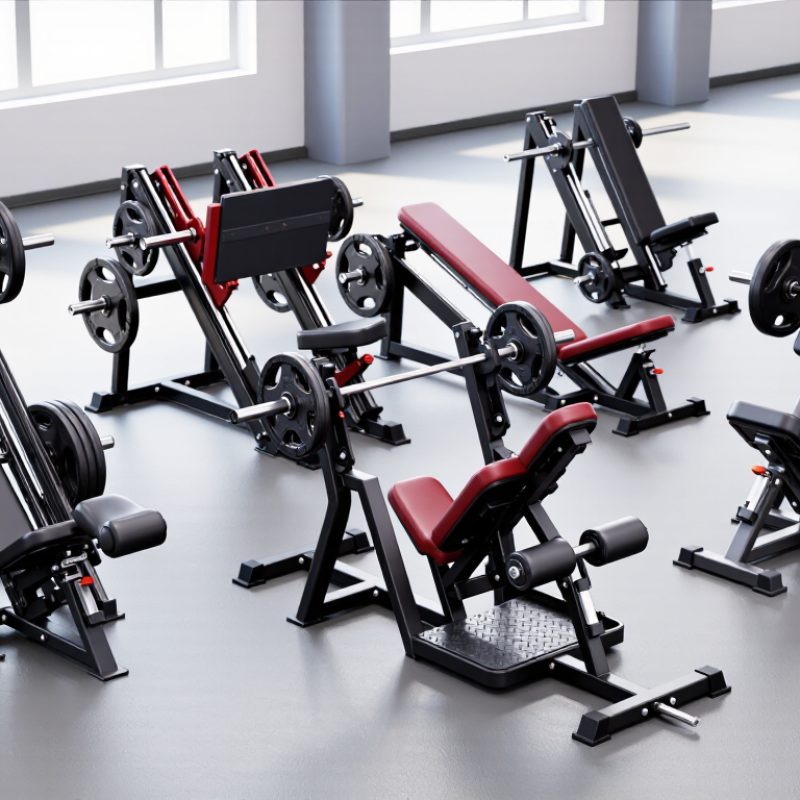
A plate-loaded leg press uses weight plates, a sled, rails, and a foot platform. The user sits or reclines, places both feet on the platform, and pushes the sled away. Plates create external resistance through gravity and the machine’s lever system. Unlike a selectorized machine, resistance changes manually. That makes loading flexible for gyms serving different strength levels.
The movement mainly trains the quadriceps, gluteus maximus, and hamstrings. Foot height and stance can shift emphasis, but they do not isolate one muscle completely. A wider stance may feel more comfortable, while excessive depth can pull the pelvis into posterior rotation. Keep the lower back supported. Never allow the knees to lock aggressively. A reliable machine should offer clear safety stops, stable rails, and a platform large enough for controlled foot placement.
Global demand supports practical equipment choices. The IHRSA 2023 Global Report recorded about 184 million fitness club members across 72 markets in 2022. That scale suggests machines must handle repeated use, varied body sizes, and frequent plate changes. In real facility checks, smooth travel often matters more than a heavy-looking frame. A machine can appear robust yet feel uneven near the bottom position. That is a warning, not a minor detail. Buyers should inspect welds, bearings, entry height, carriage stability, and the declared maximum load. Reported capacity is not the same as comfortable working capacity. Testing with several users remains necessary.
A plate-loaded leg press uses weight plates attached to a carriage that travels along angled rails. The chart shows the ideal gravitational force along the rails for a 100 kg plate load at three rail angles.
Values are calculated using force = mass × 9.81 m/s² × sin(rail angle). They represent the ideal force due to gravity, excluding carriage weight, friction, and machine-specific design factors.
A strong leg press begins with its frame, not its paint. Look for welded steel, stable footplates, and minimal carriage sway. ISO 20957-1 requires fitness equipment to address mechanical safety, stability, and user protection. Buyers should request load testing records, not accept vague claims. Check the rated capacity, plate storage, and locking mechanism under realistic gym conditions.
Biomechanics matter more than maximum weight. The seat angle should support a natural hip and knee path. Footplate width must suit different users, from shorter beginners to taller athletes. Smooth travel is essential. A rough rail can change movement quality and increase maintenance costs. The Health & Fitness Association reported 72.9 million U.S. fitness-facility members in 2023. That scale shows why commercial equipment needs simple adjustments and durable contact points.
User access deserves equal attention. A clear entry path, visible safety stops, and quick seat adjustment reduce hesitation. ACSM’s 2024 Worldwide Survey keeps traditional strength training among leading fitness trends, supporting continued demand for plate-loaded machines. Still, I would not choose by trend data alone. I would test ten controlled repetitions, inspect welds closely, and measure the machine’s footprint. No checklist catches every awkward movement. A prototype may feel excellent, yet fail during busy-hour use. That is worth questioning.
Global buyers need more than a heavy sled and a polished frame. The Health & Fitness Association reported about 184 million fitness-club members worldwide in 2023, increasing demand for durable, space-efficient strength equipment. ACSM’s 2024 Worldwide Survey also kept traditional strength training among the leading fitness trends. These figures support careful equipment selection, but they do not replace hands-on testing.
Profile 1 is a 45-degree sled press, offering familiar movement and strong glute engagement. Profile 2 uses a compact vertical frame for facilities with limited floor space. Profile 3 features independent footplates, helping users train left-right differences. Profile 4 adds a converging carriage path for a more natural press. Profile 5 uses a wide platform, supporting varied foot positions and taller users. Profile 6 includes an adjustable back pad, improving hip and knee alignment. Profile 7 combines leg press and hack-squat functions, saving equipment space. Profile 8 uses linear bearings and sealed guides for smoother travel in dusty environments. Profile 9 provides dual loading horns, reducing plate interference during high-volume sessions. Profile 10 offers a low-entry platform, useful for older adults and rehabilitation-focused gyms.
Each profile should be checked against ISO 20957 requirements, manufacturer load testing, weld quality, and replacement-part availability. A practical review should measure starting resistance, carriage noise, handle reach, and platform stability. One weakness remains: published load ratings rarely explain long-term wear. Test the machine personally. A quiet carriage may still hide poor alignment, while a large frame may waste valuable training space.
Profiles of 10 Plate-Loaded Leg Press Machines for Global Buyers
| Rank | Machine Profile | Press Angle | Approx. Footprint | Approx. Machine Weight | Recommended User Height | Typical Load Capacity | Weight Plate Sleeves | Adjustment & Safety Features | Typical Buyer Application |
|---|---|---|---|---|---|---|---|---|---|
| 1 |
45-Degree Commercial Leg Press
Heavy-duty sled design with a large angled footplate and four-point carriage guidance.
|
45° | 235 × 155 × 145 cm | 280–330 kg | 160–200 cm | 350–450 kg | 4 Olympic sleeves, approximately 50 mm diameter | Adjustable back pad, multi-position safety catches, linear bearings, non-slip footplate | Commercial gyms, strength clubs and high-traffic fitness facilities |
| 2 |
Compact 45-Degree Leg Press
Space-efficient angled sled intended for facilities with limited floor area.
|
45° | 215 × 135 × 140 cm | 210–260 kg | 155–195 cm | 250–350 kg | 2 Olympic sleeves, approximately 50 mm diameter | Adjustable seat angle, mechanical stop positions, safety handles, reinforced steel frame | Apartment gyms, boutique studios and medium-size commercial gyms |
| 3 |
Heavy-Duty Linear Bearing Leg Press
Reinforced four-rail carriage system designed for frequent heavy loading.
|
45° | 245 × 165 × 150 cm | 320–390 kg | 165–205 cm | 450–550 kg | 4 Olympic sleeves, approximately 50 mm diameter | Four linear guide rails, adjustable safety stops, oversized footplate, commercial-grade bearings | Strength and powerlifting facilities with high-volume use |
| 4 |
Horizontal Plate-Loaded Leg Press
Horizontal pressing path that can be easier to access for some users and facilities.
|
Approximately 0° | 220 × 115 × 145 cm | 190–250 kg | 155–200 cm | 250–400 kg | 2–4 Olympic sleeves, depending on frame configuration | Adjustable seat and backrest, lockable starting position, enclosed guide tracks, wide footplate | General fitness centers, rehabilitation-focused gyms and hotels |
| 5 |
Hack Squat and Leg Press Combination
Dual-purpose unit combining a plate-loaded leg press with a reverse hack squat station.
|
Approximately 45° | 235 × 175 × 155 cm | 300–370 kg | 160–200 cm | 350–450 kg | 4 Olympic sleeves, approximately 50 mm diameter | Adjustable shoulder pads, safety handles, locking catches, oversized footplate and back support | Small commercial gyms seeking multiple lower-body exercises in one station |
| 6 |
Angled Leg Press with Adjustable Backrest
Versatile sled press offering several backrest positions for different hip and knee angles.
|
40–45° | 225 × 145 × 145 cm | 230–290 kg | 155–200 cm | 300–400 kg | 4 Olympic sleeves, approximately 50 mm diameter | Three to five backrest settings, adjustable safety stops, padded carriage and textured footplate | Multi-user facilities serving a broad range of body sizes |
| 7 |
Wide-Platform Commercial Leg Press
Broad foot platform supporting conventional, wide-stance and controlled single-leg variations.
|
45° | 240 × 160 × 150 cm | 270–340 kg | 160–205 cm | 350–500 kg | 4 Olympic sleeves, approximately 50 mm diameter | Large textured footplate, adjustable carriage stops, dual safety handles, high-strength welds | Performance gyms, athletic training centers and larger health clubs |
| 8 |
Low-Profile Plate-Loaded Leg Press
Lower overall frame height designed to improve visibility and simplify placement under low ceilings.
|
35–45° | 220 × 145 × 125 cm | 210–270 kg | 150–195 cm | 250–350 kg | 2–4 Olympic sleeves, approximately 50 mm diameter | Low-entry carriage, adjustable seat, mechanical safety locks, reinforced base and rubber feet | Basement gyms, residential training rooms and compact fitness studios |
| 9 |
Vertical Leg Press
Upright pressing configuration with a smaller footprint than most 45-degree sled designs.
|
Approximately 80–90° | 150 × 125 × 155 cm | 150–220 kg | 150–195 cm | 200–300 kg | 2–4 Olympic sleeves, approximately 50 mm diameter | Adjustable back support, locking carriage, padded head and shoulder area, emergency stop position | Home gyms and facilities where floor space is the primary constraint |
| 10 |
Entry-Level Commercial Plate-Loaded Leg Press
Straightforward sled construction offering essential pressing functions at a moderate equipment size.
|
45° | 215 × 140 × 140 cm | 180–240 kg | 155–195 cm | 250–300 kg | 2 Olympic sleeves, approximately 50 mm diameter | Fixed or limited-adjustment back pad, manual safety catches, powder-coated frame, non-slip footplate | Budget-conscious gyms, schools, hotels and training facilities |
Note: Specifications are representative market ranges for comparable plate-loaded leg press configurations. Actual dimensions, rated loads, materials, adjustment ranges and shipping weights may vary by model, manufacturing standard and configuration. Allow additional clearance around the machine for loading plates and safe user access.
Top 10 Plate Loaded Leg Press Machines for Global Buyers
Comparing Performance, Safety, and Space Requirements
Choosing among the top ten plate loaded leg press machines requires more than comparing maximum load. Performance depends on sled smoothness, carriage stability, footplate angle, and usable range of motion. During equipment reviews, I check whether the sled moves evenly under light and heavy plates. A machine that feels powerful but binds near the bottom needs closer inspection. That weakness can affect confidence and training quality.
Safety starts with adjustable stops, secure handles, stable platforms, and clear access to the release mechanism. Some designs offer impressive depth, yet their starting position may feel uncomfortable for shorter users. This matters in shared gyms. Look for reinforced pivot points, guarded moving parts, and durable bearings. Maintenance access also affects reliability. Poorly placed grease points can turn routine servicing into an avoidable problem.
Space requirements often decide the final purchase. Measure the machine, loading area, user path, and ceiling clearance before ordering. Leave room for plates beside the carriage. Noise matters too. A compact frame may suit a private studio, while a longer rail system can provide smoother movement in a larger facility. Shipping weight, floor loading, and regional service support deserve attention from global buyers. My ranking is practical, not absolute. User height, training style, and available flooring can change the best choice. There is no perfect machine.
Global Purchasing Factors: Shipping, Compliance, and After-Sales Support
A plate loaded leg press is heavy, bulky equipment, so shipping details deserve close attention. Ask for the packed dimensions, gross weight, and loading method before comparing quotes. A machine that fits a 40-foot container may still need careful unloading at the destination. Confirm who handles customs paperwork, local delivery, and any liftgate or forklift requirements. Get the Incoterm and delivery responsibilities in writing. Small omissions can become expensive.
Compliance is not just a label on a product sheet. Request applicable test reports, electrical specifications if the machine includes powered features, and documentation for materials that may be subject to destination-market requirements. Check that the serial number and assembly instructions match the delivered unit. Requirements vary by country, so verify them with a qualified local advisor. Do not assume one certificate covers every market.
After-sales support matters when a carriage sticks or a guide rod arrives scratched. Ask whether replacement parts are stocked locally, how quickly technical questions receive a response, and whether clear assembly videos are available. Request a parts list and warranty terms before placing an order. Test the response with a practical question. It may reveal gaps. Even experienced buyers can overlook support until a machine is already on the gym floor.
Check the welded steel frame, stable footplates, carriage movement, locking mechanism, and load-testing records. Paint can hide problems.
Smooth travel and a stable carriage support controlled repetitions. A sled that binds near the bottom deserves closer inspection.
Look for suitable footplate width, clear entry access, and quick seat adjustment. Test the starting position with shorter and taller users.
Adjustable safety stops, secure handles, stable platforms, and an easy-to-reach release mechanism are essential. Keep the stops visible.
Try ten controlled repetitions. Check starting resistance, carriage noise, handle reach, footplate stability, and movement under different loads.
Measure the full frame, plate-loading area, user path, and ceiling clearance. Leave room beside the carriage for plates.
Compact vertical frames can suit smaller rooms. Low-entry platforms may help older adults, while combination units can save floor space.
Not fully. Published ratings rarely show long-term wear, so inspect welds and ask about replacement parts. I would still question vague claims.
Check bearing quality, guide protection, and access to lubrication points. Poor access can make routine servicing a hassle.
No. User height, training style, flooring, available space, and service support all matter. A quiet sled can still be poorly aligned.
This guide explains how a Plate-Loaded Leg Press works, from loading weight plates onto its resistance system to controlling the sled through a smooth, stable range of motion. It outlines the main criteria buyers can use to assess leg press machines, including frame strength, movement quality, adjustability, user comfort, safety features, and ease of maintenance. Profiles of ten machine types highlight the different designs and configurations available to facilities with varied training needs.
The article also compares performance, safety, and space requirements to help buyers identify equipment suited to their intended users and floor plans. For international purchasing, it considers practical factors such as shipping arrangements, product documentation, applicable compliance requirements, installation, spare parts, and after-sales support. Together, these points provide a clear framework for comparing options and making an informed purchase for a gym or training facility.